Homes with Digital Twins
Transformation of the Domestic Space
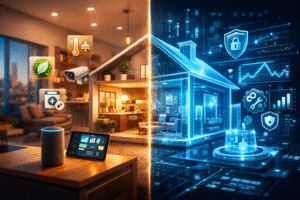
Homes with Digital Twins. The concept of the smart home is evolving into a more advanced model: the home digital twin. Rather than being limited to connected devices, this approach creates a comprehensive virtual replica of the residence. This digital representation integrates structural data, energy consumption metrics, and daily usage patterns. As a result, the home is no longer just an automated environment; it becomes an intelligent system capable of analyzing, predicting, and optimizing its own performance. In this context, the convergence of IoT sensors, data analytics, and artificial intelligence enables more efficient and personalized home management.
Technological Architecture
The technological foundation of this model relies on IoT ecosystems developed by companies such as Google, through Google Nest, and Amazon, through Alexa. These platforms collect environmental data, including temperature, humidity, electricity consumption, and occupancy. Homes with Digital Twins. This data then feeds predictive models that optimize energy use and enhance comfort. According to the International Energy Agency, residential digitalization can reduce energy consumption by 10% to 20%. Therefore, integrating digital twins into homes provides not only convenience but also measurable efficiency and sustainability benefits.
Benefits and Implementation Challenges
From a practical standpoint, the home digital twin enables thermal simulations that improve energy efficiency and anticipate fluctuations in consumption. It also supports predictive maintenance of appliances by detecting anomalies before they become critical failures. In addition, it enhances security through behavioral pattern analysis and the detection of unusual activities.
However, implementation presents important challenges. First, interoperability among devices from different manufacturers remains limited. Second, home cybersecurity becomes increasingly critical, as the growth of connected data expands the potential attack surface. Consequently, the success of the home digital twin will depend not only on technological innovation but also on open standards and robust security protocols.
Related posts