The digitalization of daily transportation
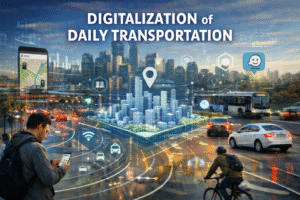
Platforms and Data in the Digitalization of Everyday Transportation

The digitalization of daily transportation has significantly transformed the management of urban mobility. Each day, millions of trips generate vast amounts of data, enabling the creation of urban digital twins that integrate real-time information on traffic conditions, public transportation systems, and user behavior. Platforms such as Uber and Waze collect large-scale mobility data that power these intelligent systems. Furthermore, research published in Transportation Research Part C demonstrates that predictive models based on mobility data can forecast traffic congestion with high accuracy, thereby improving urban planning and decision-making processes.

Practical Applications

In everyday life, digital twin–based analytical methods provide tangible benefits for both citizens and public administrations. Predictive systems optimize personal travel routes using real-time data, reduce commuting times by anticipating traffic disruptions, and support more efficient public transportation planning. Through artificial intelligence and advanced digital modeling, cities can simulate multiple scenarios before implementing policy or infrastructure changes. This proactive approach enhances responsiveness to incidents and variations in travel demand.

Social Impact

The digitalization of daily transportation represents a huge transform in daily productivity.  The integration of urban digital twins contributes to lower emissions by optimizing traffic flows and reducing idle time.  Also, currency global population needs that types of mechanism for improve the performance of transportation companies. It also improves logistical efficiency and promotes more sustainable use of existing infrastructure. Overall, this data-driven approach not only enhances the daily mobility experience but also supports the development of smarter, more sustainable, and more resilient cities capable of addressing the challenges of urban growth. In this context, the continuous integration of data analytics and intelligent infrastructure will be essential to ensuring long-term efficiency, sustainability, and adaptability in urban transportation systems.


Share on social networks
Al Valdivia

Software Developer which has participated in several software development projects as developer, analyst and tester in technnologies as Python and JavaScript and linked to different development frameworks like FastApi, Django, RestFull API, GraphQL, Bootstrap, etc. Passionated of digital world and digital transforming process.

More post (55)

Leave a Reply

Your email address will not be published. Required fields are marked *

This site uses Akismet to reduce spam. Learn how your comment data is processed.

In this article