Hybrid Architectures in Predictive Maintenance
The Convergence of AI and Digital Twins
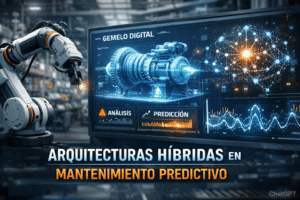
Hybrid Architectures in Predictive Maintenance. In the context of Industry 4.0, predictive maintenance has become a key strategy for reducing unexpected failures. It also helps optimize resources and extend the lifespan of industrial assets. Unlike traditional reactive or preventive approaches, this model uses digital twins powered by real-time data and artificial intelligence (AI). As a result, companies can detect potential failures before they occur.
Digital twins are virtual replicas of physical assets. They continuously receive data from IoT (Internet of Things) sensors. Consequently, engineers can simulate equipment behavior under different operating conditions. Moreover, when AI—especially machine learning—is integrated, the system becomes more intelligent. It can process large volumes of data and generate actionable insights. Therefore, organizations can make faster and more accurate decisions.
Hybrid Architectures in Predictive Maintenance
A hybrid architecture combines data-driven models with physics-based simulations. On the one hand, physics-based models replicate the laws and constraints of the system. Hybrid Architectures in Predictive Maintenance. On the other hand, machine learning models detect complex and nonlinear patterns in historical data. By integrating both approaches, companies achieve more reliable and contextual predictions. As a result, predictive maintenance becomes more accurate and efficient.
Industrial Benefits and Use Cases
This approach is transforming manufacturing and energy sectors. For example, General Electric uses digital twins to monitor turbines and engines. Consequently, the company has reduced downtime by 30% to 50%. In addition, it has improved operational efficiency.
Similarly, advanced manufacturing plants use real-time data combined with digital simulations. Therefore, maintenance tasks are scheduled only when necessary. This strategy prevents over-maintenance and reduces operational costs. At the same time, asset reliability remains high.
Moreover, consulting firms such as Deloitte and PwC predict significant growth in this field. According to their forecasts, by 2026, AI-powered digital twins will become standard in high-risk and complex industries.
Related posts