Digital Twins: Digital Innovation for Real Processes
Digital Twins (DTs) are virtual representations that enable the precise recreation of physical objects, processes, systems, or even human beings in the digital environment. This technology is based on the integration of various technological tools, such as the Internet of Things (IoT), Artificial Intelligence (AI), Machine Learning, and real-time data analysis. Thanks to this combination, it is possible to design a digital twin of virtually any entity, ranging from an aircraft engine to a wind farm.
Functioning and Applications
Digital twins operate through the collection of data via sensors that monitor the performance of the physical object. These data are transmitted to a virtual model that simulates the behavior of the object in real time, thus enabling continuous analysis and optimization. For instance, in a wind turbine, sensors can measure variables such as energy production and weather conditions, allowing for adjustments to be made to maximize efficiency.
Benefits
The benefits of using digital twins are numerous:
- Remote monitoring: They facilitate control and monitoring of installations without physical presence, reducing risks in dangerous environments.
- Predictive maintenance: They allow anticipating failures and optimizing asset lifecycle due to constant information about its state.
- Continuous improvement: As more data is collected, digital models adjust and improve, resulting in higher operational efficiency.
Types of Digital Twins
There are several types of digital twins, each adapted to different levels of complexity and application:
- Component-level twins: Represent individual parts within a system.
- Asset-level twins: Group multiple components that work together.
- Process-level twins: Simulate the complete operation of a system or installation.
Main idea
The main idea behind using DTs is to create a virtual replica that allows analyzing, simulating, and optimizing the functioning of an object in real-time. Digital twins consist of three parts: physical product, virtual product, and connections generated between them.
This representation is created using real-time data and advanced models to simulate the behavior, characteristics, and condition of the object or being it represents. The final result is constructed based on the quantity of data employed to create and update it.
Advancements
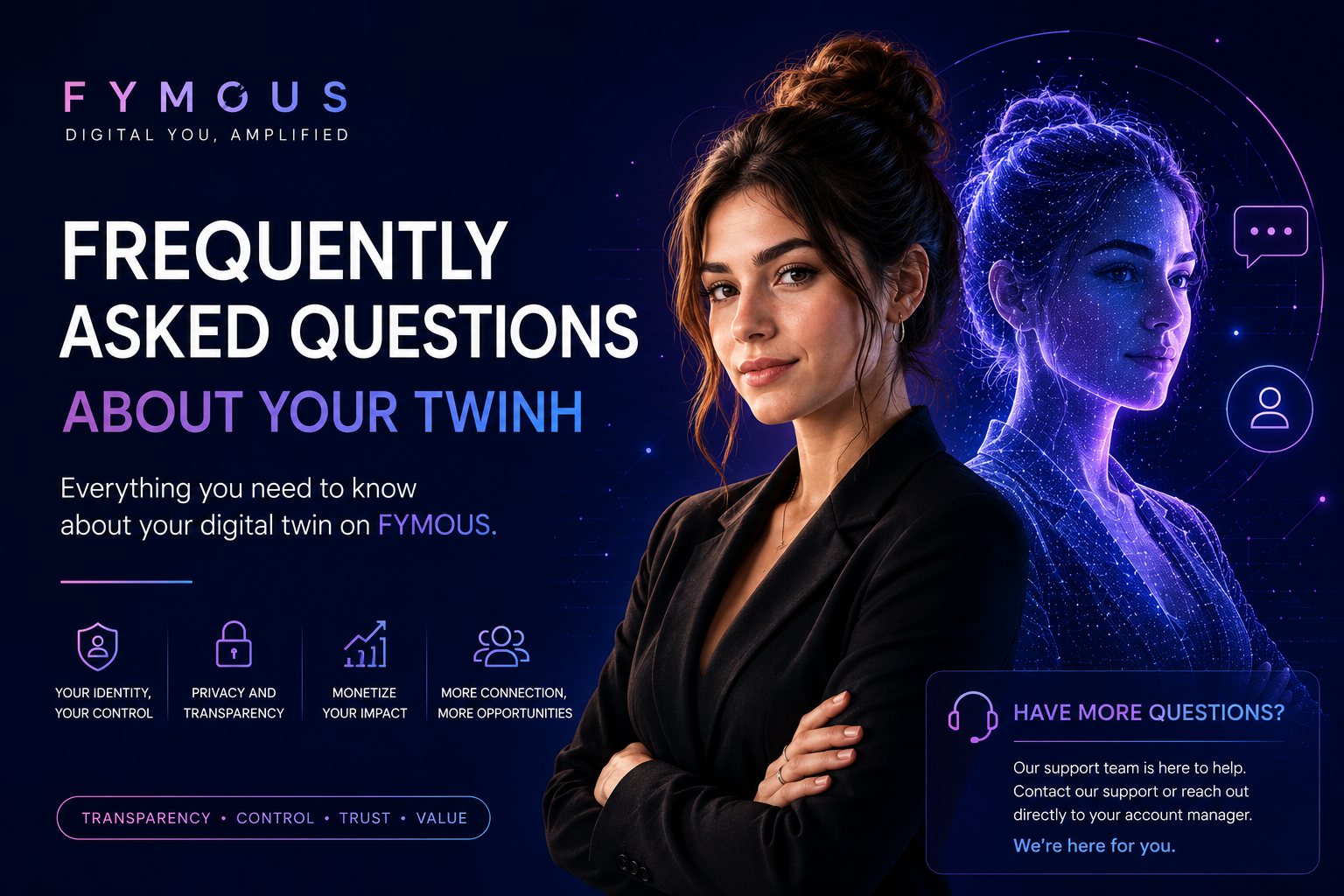
With current advancements, DTs have become virtual representations of a human being, specifically users, designed to assist and aid in various tasks. Using advanced technology, digital twins can learn and adapt to user needs, providing real-time information and support.
This technology enables improved validity and productivity by offering personalized experiences tailored to the specific demands of each individual.
Application of digital twins in FySelf
In the case of FySelf, these DTs are designed to function as multi-role assistants capable of performing a wide variety of functions, from answering questions to helping organize daily tasks. Conceived as a sovereign digital entity, whose management and sharing remain exclusively in the hands of its human counterpart, ensuring total control and conscious management of its virtual twin. It can be configured to perform a range of tasks, including personal assistance, language translation, medical reminders, and even project design for both professional and personal projects.
Key points about Digital Twins
- Simulation and Modeling: Digital twins use mathematical models and simulations to replicate the behavior and characteristics of objects or human beings in the real world. This allows predicting how they will behave under different conditions and scenarios.
- Real-Time Data: Digital twins are continuously updated with real-time data from sensors, IoT devices, and other sources. This ensures that the digital representation remains accurate and up-to-date.
- Analysis and Optimization: By analyzing digital twin data, patterns, trends, and areas for improvement can be identified, allowing for optimized performance, failure prediction, and informed decision-making.
- Industrial Applications: In manufacturing, digital twins are used to monitor and optimize production processes. In healthcare, they can represent patients for personalized treatments and health status monitoring. In asset management, they help maintain and manage complex infrastructure.
- Human Interaction: In the case of human digital twins like myself, they are used to provide customized assistance, improve productivity, and offer support in various tasks. These digital twins can learn and adapt to user needs, providing a more efficient and personalized experience.
Summary
Digital twins are a powerful tool that combines real-time data, simulation, and analysis to create precise and useful virtual representations of objects, systems, and human beings. This enables better decision-making, process optimization, and personalized solutions across various fields, including engineering, manufacturing, healthcare, and asset management.
Related posts