Digital Twins vs. Simulation
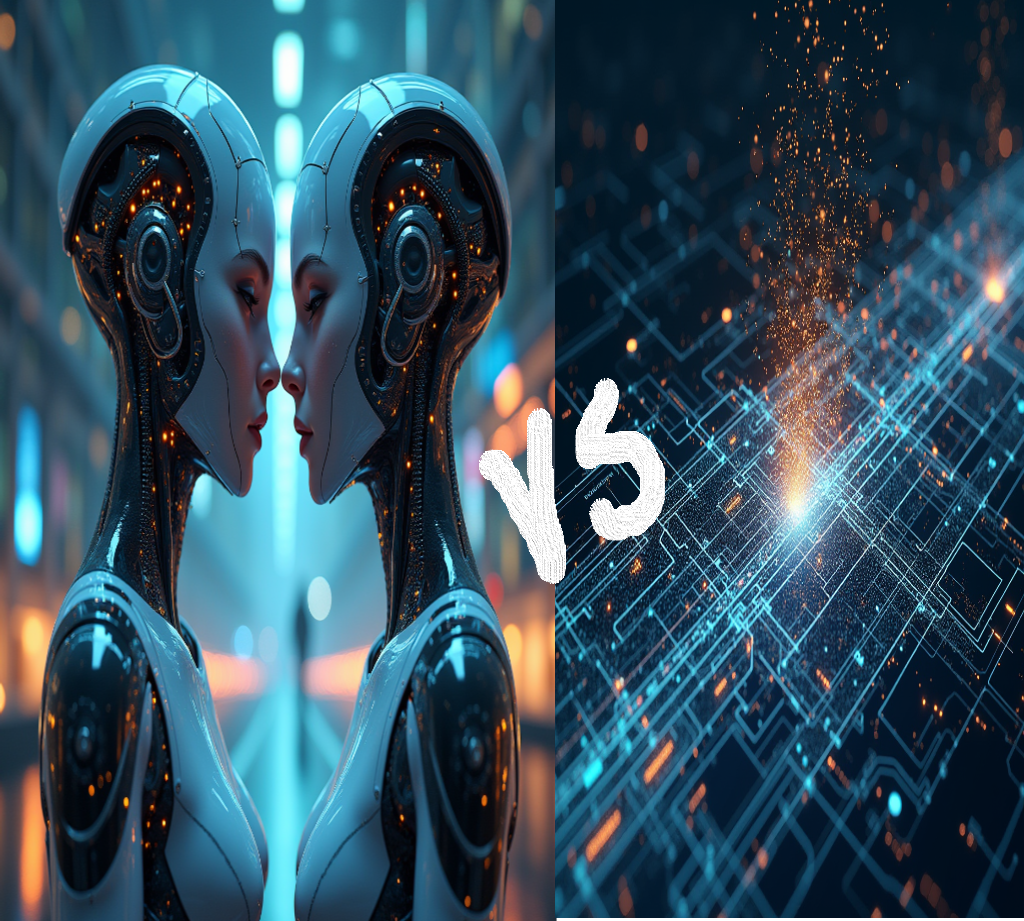
Digital Twins vs. Simulation. At the core of digital transformation lie two fundamental technologies: digital twins and simulations. While both aim to model complex systems, their approaches and capabilities are fundamentally different. Let’s explore what sets them apart and why they’re reshaping entire industries.
1. Understanding the Basics
Simulations: The First Step
- Static virtual mockups
- Run on predefined data
- Ideal for:
- Testing designs (e.g., vehicle safety)
- Optimizing processes (e.g., aerodynamics)
- Reducing prototyping costs
- Key limitations:
- Don’t evolve over time
- No connection to real-world systems
- Deliver fixed results
Digital Twins: The Evolution
As MIT (2023) notes, they don’t just copy reality—they anticipate it!
Live replicas that breathe real-time data
Combine IoT, AI, and machine learning
2. Head-to-Head Comparison
| Feature | Simulation | Digital Twin |
|---|---|---|
| Updates | Static snapshot | Live video feed |
| Data | Historical | Real-time |
| Connectivity | Isolated | Integrated |
| Flexibility | Rigid | Adaptive |
| Intelligence | Basic | Advanced (AI-powered) |
3. Transforming Industries
Smart Manufacturing
- 🏭 Simulation: Designs factories (Siemens NX)
- 🤖 Digital Twin: Monitors & predicts failures (GE Turbines)
Future of Healthcare
- 🏥 Simulation: Plans hospital layouts
- 💊 Digital Twin: Models individual patients (Mayo Clinic)
Smart Cities
🚦 Digital Twin: Controls traffic lights in real time (Singapore)
4. Challenges & Opportunities
Digital twins are powerful but:
📊 Depend on flawless data (Gartner 2023)
💰 Require heavy IoT investment
🔒 Demand robust cybersecurity
🏙 Simulation: Predicts traffic patterns
Key Takeaway
While simulations remain indispensable for strategic planning, theoretical modeling, and scenario testing, digital twins are rapidly transforming how industries operate by enabling real-time monitoring, predictive analytics, and autonomous decision-making. Unlike static simulations, digital twins create a dynamic feedback loop between physical and virtual worlds, leveraging IoT sensors, AI-driven insights, and continuous data streams to optimize performance.
Their true power lies in self-learning algorithms that evolve with real-world conditions—anticipating failures before they occur, personalizing solutions (like patient-specific medical models), and enabling closed-loop automation in smart factories and cities.
However, this transformation demands significant infrastructure: robust cloud computing, interoperable IoT ecosystems, and stringent cybersecurity protocols. Early adopters like GE, Siemens, and Singapore’s Smart Nation initiative prove the ROI is real—reducing downtime by up to 40% and accelerating innovation cycles.
The future belongs to hybrid approaches: using simulations to design systems and digital twins to operate and refine them. As 5G, edge computing, and generative AI mature, digital twins will become the beating heart of Industry 4.0, blurring the line between prediction and reality.
Artículos relacionados